Sam Altman OpenAI Trial April 27: Elon Musk’s Lawsuit, the $1T IPO Trap, and the AI Domino That Could Crush Microsoft, Nvidia & Oracle
By Felixsr · Money Tips · 10 min read
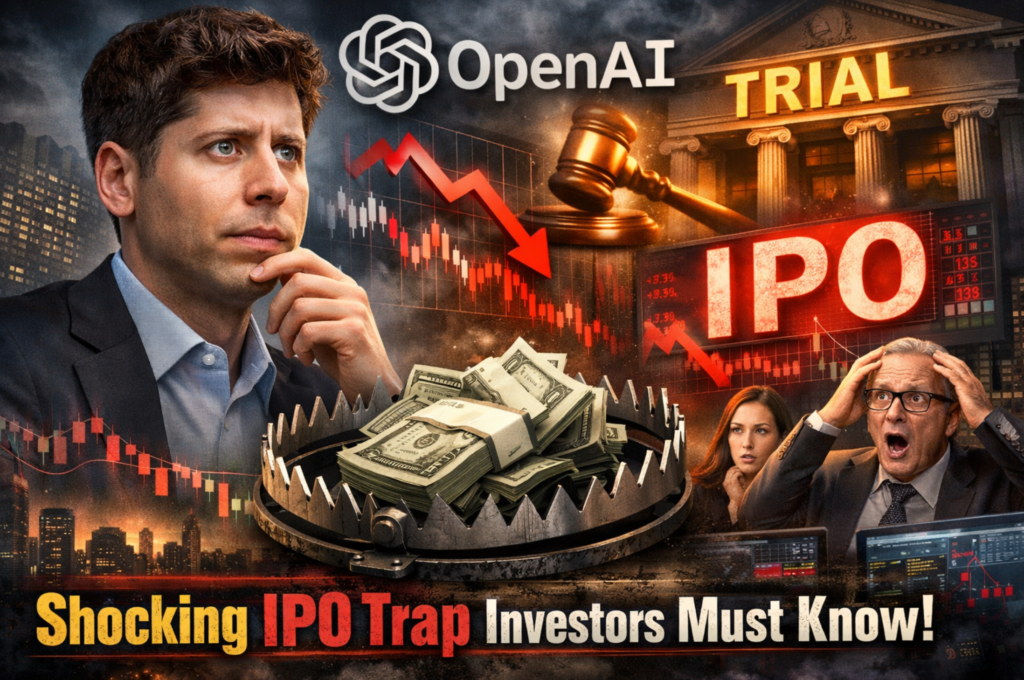
Sam Altman OpenAI trial begins April 27 — and the fallout could shake Microsoft, Nvidia, and Oracle stocks. Here’s why this lawsuit is bigger than any single verdict: a $1 trillion IPO designed to exit insiders, $140 billion in projected losses, and a 70-page document accusing Altman of systematic deception. Every investor in AI needs to read this before the gavel drops.
What Is the Sam Altman OpenAI Trial — And Why Does It Matter to Investors?
The Sam Altman OpenAI trial kicking off April 27 is not a typical corporate dispute. This is Elon Musk’s lawsuit alleging that OpenAI — originally founded as a nonprofit dedicated to the safe development of AI for humanity — has been systematically converted into a for-profit vehicle benefiting insiders, with Sam Altman at the center.
The implications stretch far beyond OpenAI itself. Microsoft, Nvidia, and Oracle have built billions of dollars of business on the assumption that OpenAI’s growth story is real, stable, and sustainable. If the Sam Altman OpenAI trial cracks that foundation, the ripple effects could hit AI stocks across the board.
The $1 Trillion IPO Trap: Are Retail Investors the Exit Liquidity?
OpenAI is targeting a Q4 2026 IPO at a valuation of up to $1 trillion. CFO Sarah Friar publicly promised that retail investors would receive guaranteed IPO allocations — an unusual move that immediately raised eyebrows on Wall Street.
The reason for skepticism is straightforward: institutional investors are pouring billions into Anthropic but ignoring OpenAI shares in the secondary market. When the smart money is selling and the pitch is being directed at individual investors, the pattern is familiar — and alarming.
“The pattern is classic: institutional capital needs an exit, so the IPO narrative is engineered to attract retail. The question is who ends up holding the bag when the growth story meets the actual financials.”
| Factor | What’s Happening | Red Flag? |
|---|---|---|
| IPO Valuation | $1 trillion target for Q4 2026 | 🚩 Yes — loss-making at $140B/yr |
| Retail allocation promise | CFO guarantees retail IPO access | 🚩 Unusual — signals institutional cold shoulder |
| Secondary market | Institutions avoiding OpenAI shares | 🚩 Institutions buying Anthropic instead |
| CFO relationship | CFO excluded from key meetings by Altman | 🚩 CFO doesn’t report to CEO — governance breakdown |
Ronan Farrow’s Investigation: Sam Altman’s Pattern of Deception
Pulitzer Prize-winning journalist Ronan Farrow — the reporter who broke the Harvey Weinstein story that launched the MeToo movement — spent 18 months interviewing over 100 people inside and around OpenAI. His findings paint a portrait of a CEO with a systematic pattern of deception that has accelerated as the stakes have grown.
| Allegation | Detail |
|---|---|
| False board reporting | Allegedly misled the board before GPT-4 launch; deployed without full safety review |
| Safety budget lie | Promised 20% of resources to safety research; actual allocation was 1–2% with outdated servers |
| DOD contract poaching | Hours after publicly supporting Anthropic’s ethics stance, secured the DOD contract Anthropic refused on principle |
| Microsoft’s internal view | Senior MS executive reportedly compared Altman to Madoff and Sam Bankman-Fried in internal communications |
“What emerged across 100+ interviews was a consistent picture: a leader who tells different stories to different audiences, and whose public commitments to safety have not been matched by the internal resources actually allocated to it.”
Why Elon Musk Dropped $150 Billion — And Is Now Only Asking for One Thing
The most revealing aspect of the Sam Altman OpenAI trial is what Musk is no longer asking for. He has voluntarily dropped his original $150 billion damages claim. In its place, he is asking for exactly two things: Sam Altman’s removal as CEO and restoration of OpenAI’s nonprofit structure.
OpenAI’s legal team has attempted to frame the lawsuit as a billionaire using litigation as a harassment tool. But that framing collapses when the billionaire voluntarily walks away from $150 billion. The move reframes the entire case — from a financial dispute into a question of personal character and institutional integrity.
“Dropping the damages claim was brilliant. It strips away OpenAI’s ‘billionaire bullying’ defense and leaves only one question on the table: Did Sam Altman and OpenAI betray their founding mission? That’s a question a jury can answer.”
The AI Domino Effect: How the Sam Altman OpenAI Trial Could Crash Microsoft, Oracle, and Nvidia
The financial exposure extends far beyond OpenAI. Three major companies have built their near-term growth stories on OpenAI’s stability — and each faces a distinct but severe risk if the Sam Altman OpenAI trial goes badly.
| Company | OpenAI Exposure | Worst-Case Risk |
|---|---|---|
| Microsoft (MSFT) | Exclusive Azure partnership; entire Copilot AI stack built on OpenAI | Court orders contract renegotiation → cost explosion |
| Oracle (ORCL) | Borrowed ~$50B to build data centers based on OpenAI contracts | OpenAI instability → credit downgrade → bankruptcy risk |
| Nvidia (NVDA) | Cut OpenAI investment plan from $100B → $30B; circular revenue concerns growing | Internal skepticism rising on “self-funding revenue loop” |
The Sam Altman OpenAI Trial: Three Scenarios and What Each Means for Your Portfolio
The market has largely ignored this trial. That’s a mistake. Three outcomes are possible, and two of them are bad for AI stocks.
Bottom line: The trial itself is an asymmetric risk event. The upside from a clean OpenAI win is modest. The downside from scenarios B or C is severe. Investors with heavy AI stock exposure should hedge before April 27.
What to Watch: Key Trial Milestones After April 27
Bottom Line: The Sam Altman OpenAI Trial Is the AI Market’s Biggest Unpriced Risk
The Sam Altman OpenAI trial deserves far more attention from investors than it is currently receiving. The combination of a credible investigative journalism record, a well-funded plaintiff willing to forgo billions in damages, documented internal dissent, and a loss-making company targeting a $1 trillion valuation — represents a rare convergence of legal, financial, and reputational risk.
- OpenAI IPO investors: Understand that you may be the intended exit liquidity. The institutional cold shoulder on secondary shares is a signal, not a coincidence.
- Microsoft holders: The Azure-OpenAI contract is the core risk. A court-ordered renegotiation would reprice MSFT’s AI unit economics overnight.
- Oracle holders: $50B in debt tied to OpenAI contracts is existential exposure. This is the highest binary risk in the AI sector right now.
- Nvidia holders: The circular revenue structure is already generating internal skepticism — and the $100B → $30B investment cut signals management agrees.
Sources & Further Reading
- The New Yorker — Ronan Farrow’s investigation into Sam Altman ↗
- Bloomberg — OpenAI $1 trillion IPO valuation target ↗
- Reuters — Musk v. OpenAI trial preview ↗
- Financial Times — OpenAI projected losses 2026–2029 ↗
- Wall Street Journal — Oracle data center debt exposure ↗
- CNBC — Nvidia cuts OpenAI investment commitment ↗
⚠️ Disclaimer: This post is for informational purposes only and does not constitute financial or investment advice. All projections cited are from third-party sources. Always conduct your own research before making investment decisions.