
📊 Economics Analysis
Will the Middle East War Ever End?
What Experts Are Saying
A data-driven look at the conflict — and what the world’s leading analysts predict for the future.
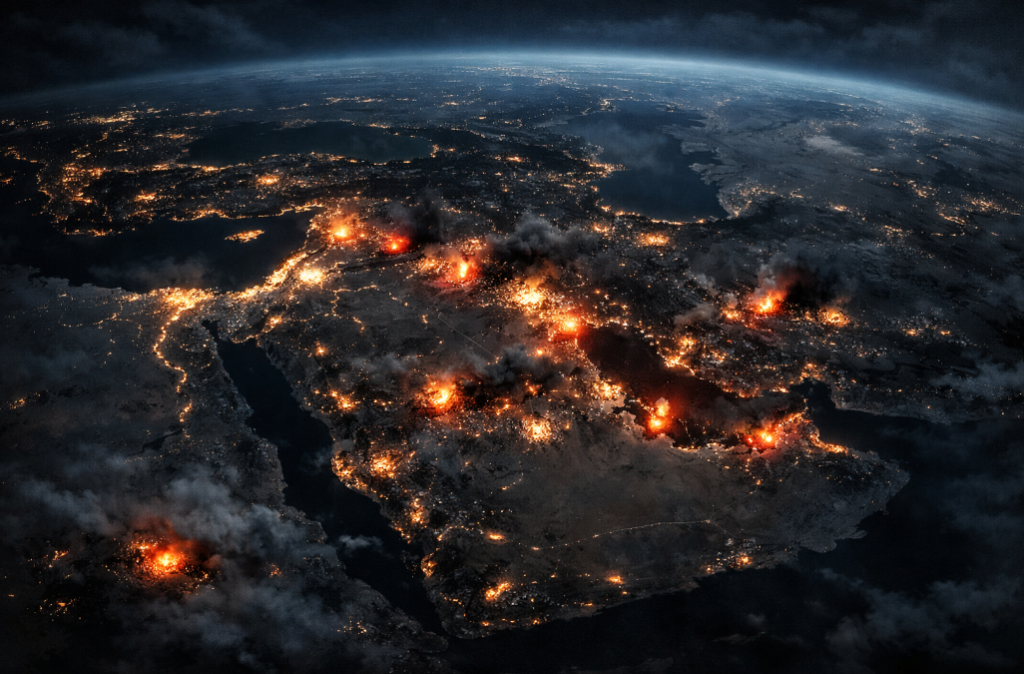
The Middle East has been in a state of conflict for decades — but the wars erupting since 2023 have reached a new level of intensity. With the US-Israel war against Iran now entering its third week, Gaza still in crisis, and multiple proxy conflicts raging across the region, the world is asking one simple question: will this ever end?
We looked at the latest reports from leading think tanks, foreign policy experts, and international analysts to give you a clear, honest picture of where things stand — and what might happen next.
🔍 Where Things Stand Right Now
As of early 2026, the Middle East is dealing with multiple overlapping conflicts simultaneously:
- 🇮🇱 Israel vs. Gaza (Hamas): Ceasefire implemented in late 2025, but violence continues
- 🇮🇷 US-Israel vs. Iran: Active conflict, now in its third week as of March 2026
- 🇱🇧 Israel vs. Lebanon (Hezbollah): Daily Israeli strikes despite November 2024 ceasefire
- 🇾🇪 Yemen (Houthis): Threatening to resume Red Sea shipping attacks
- 🇸🇾 Syria: Post-Assad regime transition, deep uncertainty remains
💡 Key Fact: According to the International Crisis Group (March 2026), the US-Israeli war with Iran is now in its third week “with no end yet in sight” — and Iran’s closure of the Strait of Hormuz has already disrupted global oil, gas, and fertilizer exports.
Source: International Crisis Group, March 2026
🎙️ What the Experts Are Saying
Expert #1: Dara Conduit — University of Melbourne
Dara Conduit, a senior Iran researcher at the University of Melbourne, gives a sobering assessment of the current situation.
“This war is set to continue for as long as the current arrangements stay in place. Right now, I can’t see any chance of a ceasefire because the warring parties are just too far apart, and there is no middle ground between their stated goals.”
— Dara Conduit, Senior Lecturer, University of Melbourne (SBS News, March 2026)
Conduit also pointed out that regime change in Iran — a stated goal of the US and Israel — is far more complicated than simply removing a leader. “The Iranian regime is well-institutionalised across the state. It’s not hollowed out,” she noted.
Expert #2: Sanam Vakil — Chatham House
Sanam Vakil, Director of the Middle East and North Africa Programme at Chatham House (one of the world’s most respected foreign policy institutions), argues that Iran sees this as an existential fight.
“Iran views the current conflict as an existential struggle and will not seek an end until it receives guarantees that ensure the Islamic Republic’s long-term survival.”
— Sanam Vakil, Director, Middle East Programme, Chatham House (Goldman Sachs Research, March 2026)
Expert #3: Ambassador Dennis Ross — Washington Institute
Former US Special Middle East Coordinator Dennis Ross points to one critical factor that will determine when the war ends.
“This all comes down to the Strait of Hormuz. Trump cannot end the war as long as Iran controls it. So, either the US does something dramatic to deny Iran that leverage or waits until conditions shift enough to allow for a mediated outcome.”
— Ambassador Dennis Ross, Fellow, The Washington Institute for Near East Policy (Goldman Sachs Research, March 2026)
📊 Three Possible Scenarios
The Stimson Center, a leading US security think tank, outlined three possible futures for the Middle East — and their assessment is not optimistic.
| Scenario | Description | Likelihood |
|---|---|---|
| 🟡 Low-level conflict continues | Fighting drags on without major escalation or resolution | Most likely |
| 🔴 All-out regional war | Full-scale conflict engulfing multiple countries | Possible |
| 🟢 Lasting ceasefire + reconstruction | Peace deal and rebuilding of Gaza and the region | Unlikely by 2026 |
💡 Expert Consensus: The Stimson Center’s panel of US regional experts concluded that “the third scenario was seen as unlikely by 2026” — meaning a genuine, lasting peace remains a distant hope.
Source: Stimson Center, 2024
⚠️ Why This Is So Hard to End
According to the Atlantic Council, one of Washington’s most influential think tanks, the core problem is simple but devastating: every party in the conflict has completely opposite goals.
“No one should confuse the patchwork of temporary cease-fire agreements in place throughout the region for sustainable deterrence and peace, as underlying issues remain unresolved and adversaries’ desired end states remain diametrically opposed.”
— Alex Plitsas, Atlantic Council (December 2025)
On top of that, Dr. Widyane Hamdach of Saint Peter’s University warns about the global strategic cost of a prolonged war:
“Short-term operations may achieve tactical objectives, but long-term stability requires diplomacy, regional cooperation, and political legitimacy. Without such a balanced strategy, the risks of humanitarian crises, economic disruption, terrorism, and broader geopolitical escalation will continue to grow.”
— Dr. Widyane Hamdach, Saint Peter’s University (Georgetown Journal of International Affairs, April 2026)
💡 What Does This Mean for the Global Economy?
Even if you’re not directly involved, the economic ripple effects are already being felt worldwide. Here’s a quick summary of what’s happening right now:
| Impact Area | Current Status | Trend |
|---|---|---|
| 🛢️ Oil prices | Rising sharply due to Strait of Hormuz closure | ⬆️ Up |
| 🚢 Shipping costs | Disrupted — Red Sea routes threatened | ⬆️ Up |
| 🛒 Food prices | Fertilizer exports blocked via Gulf | ⬆️ Up |
| 📉 Stock markets | Volatile, especially energy and defense sectors | ⬇️ Unstable |
| 💱 US Dollar | Strengthening as safe-haven demand rises | ⬆️ Up |
🔮 Final Verdict: Will It End?
Based on the expert consensus, the honest answer is: not anytime soon.
The conflicts in the Middle East are deeply rooted in decades of political, religious, and territorial disputes. While ceasefires come and go, the underlying causes remain unresolved. Most experts agree that 2026 will look a lot like 2025 — with continued violence, temporary truces, and no fundamental change in the security situation.
🎯 Bottom Line: The Middle East war is unlikely to end soon — but staying informed helps you prepare for the economic consequences. Higher energy prices, food inflation, and market volatility are likely to continue. The best thing you can do is build financial resilience and stay updated on global developments.
📚 Sources
- International Crisis Group — Conflict and Consequences: The Global Impact of the New Middle East War
- Goldman Sachs Research — Iran Conflict: How Long and How Bad? (March 2026)
- Atlantic Council — The Middle East is on the brink of a new crisis (December 2025)
- Stimson Center — Scenarios for the Middle East to 2026 (2024)
- Georgetown Journal of International Affairs — The War Against Iran and Global Risks (April 2026)
- Foreign Policy — With Washington Distracted, a Grim Outlook for the Middle East (January 2026)